



Key Points in this Article
- AI voice cloning is now cheap, fast, and accessible to attackers.
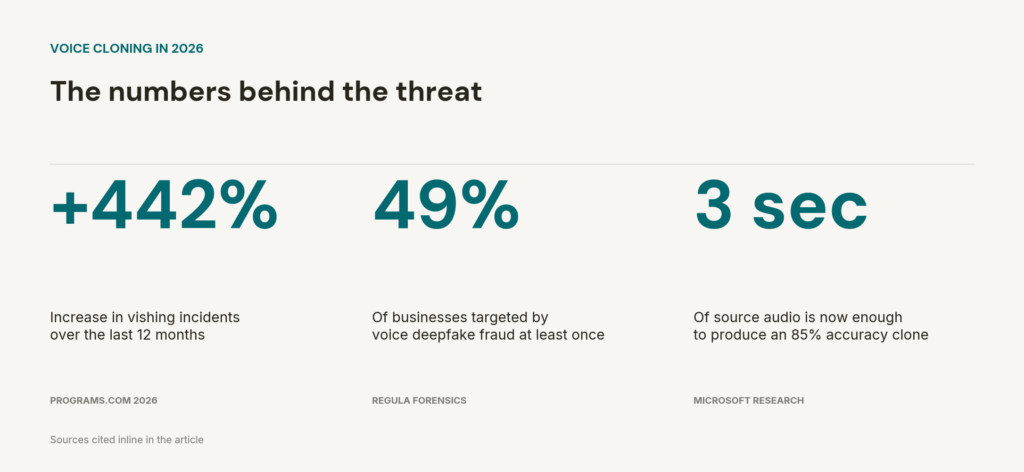
Three seconds of audio is enough to clone a CEO’s voice with 85% accuracy using open-source tools like VALL-E and XTTS-v2. Vishing incidents are up 442% year-over-year, and 49% of businesses have already been targeted by a voice or video deepfake. The technology has moved from research labs into active fraud attempts against Hudson Valley businesses. - You cannot detect a clone by ear — the only reliable defense is procedural.
Trained listeners cannot distinguish modern voice clones from real voices. The single rule that stops every voice-cloning attack is dual-channel verification: any request to wire money, change vendor banking details, or release funds — received by phone or voicemail — must be verified by calling the requester back at a known phone number before the funds move. No exceptions. - Six low-cost controls protect Hudson Valley and tristate SMBs.
A written wire-verification policy, two-person approval threshold on wires over $10,000, an executive challenge phrase, a no-voice-MFA-approval rule, a helpdesk identity-proofing script, and audio attack-surface awareness. The procedural layer costs nothing; the technical layer (AI-assisted email security, behavioral EDR) is part of a standard managed cybersecurity stack.
It’s 4:47 p.m. on a Friday. Your controller’s phone rings. The voice on the other end is your CEO — same cadence, same Hudson Valley inflection, same little throat-clearing tic. He’s at JFK, the deal is closing tonight, he needs $84,000 wired to a new supplier before the bank cuts off. Three minutes later, the wire is gone. The CEO never made the call. An AI did.
This article is written for Hudson Valley and tristate businesses — Orange, Dutchess, Ulster, Putnam, and Rockland Counties in New York, plus Bergen and Passaic in New Jersey and Fairfield in Connecticut
Why this matters right now
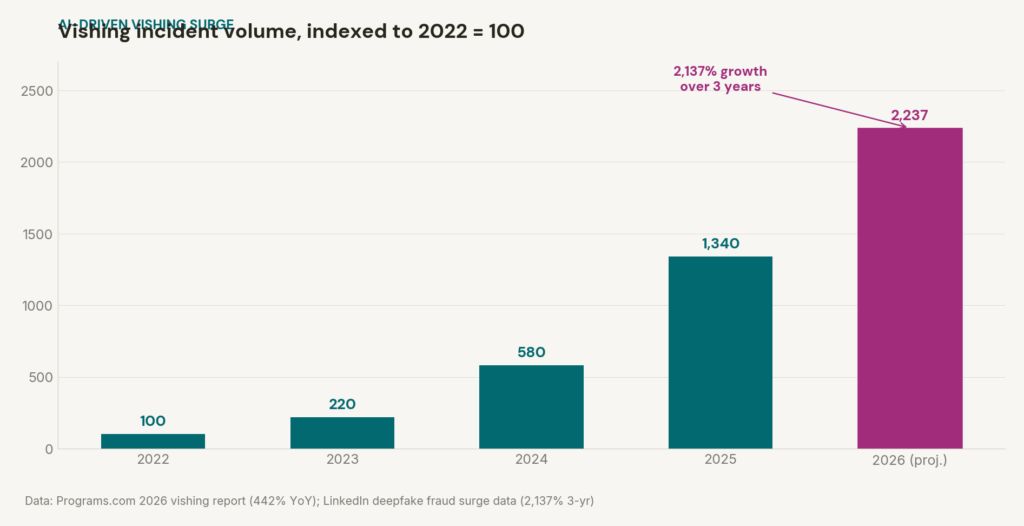
Voice-cloning fraud is no longer a 2030 problem. The FBI’s IC3 division has been warning about AI-enabled business email and voice compromise since 2024, and the latest vishing reports show a 442% year-over-year increase in voice-phishing incidents and roughly $40 billion in BEC + voice-fraud losses for 2025–2026. Microsoft Research’s VALL-E demonstrated that 3 seconds of audio is enough to produce a clone with around 85% accuracy. Regula Forensics reports 49% of businesses have already been targeted by a voice or video deepfake. Citations: FBI IC3, Microsoft VALL-E, Regula Forensics, Programs.com vishing stats.
How a voice-cloning attack actually runs
Every attack we’ve seen against managed clients in Orange, Dutchess, Ulster, and Putnam Counties follows the same three-stage pattern.

Stage 1 — Harvest
Attackers pull voice samples from your LinkedIn videos, podcast guest spots, Chamber webinars, YouTube interviews, voicemail greetings, and earnings calls. Three seconds is the floor. Thirty seconds gives them indistinguishable output.
Stage 2 — Clone
Open-source models (ElevenLabs API, VALL-E forks, XTTS-v2) turn that sample into a real-time voice. The attacker can now type any sentence and have it spoken in your CEO’s voice over a phone line.
Stage 3 — Strike
The call comes in spoofed from the executive’s real cell number (caller-ID spoofing is trivial). The script is always the same: urgency, authority, secrecy, new payment instructions. The target is finance, AP, or anyone with wire authority.
The one rule that stops every voice-cloning attack: dual-channel verification
You cannot out-listen an AI. You cannot train your ear to detect a clone — the technology is past that. You can, however, force the attack to fail by requiring verification on a second, independent channel before any wire, ACH, or vendor banking change is approved.
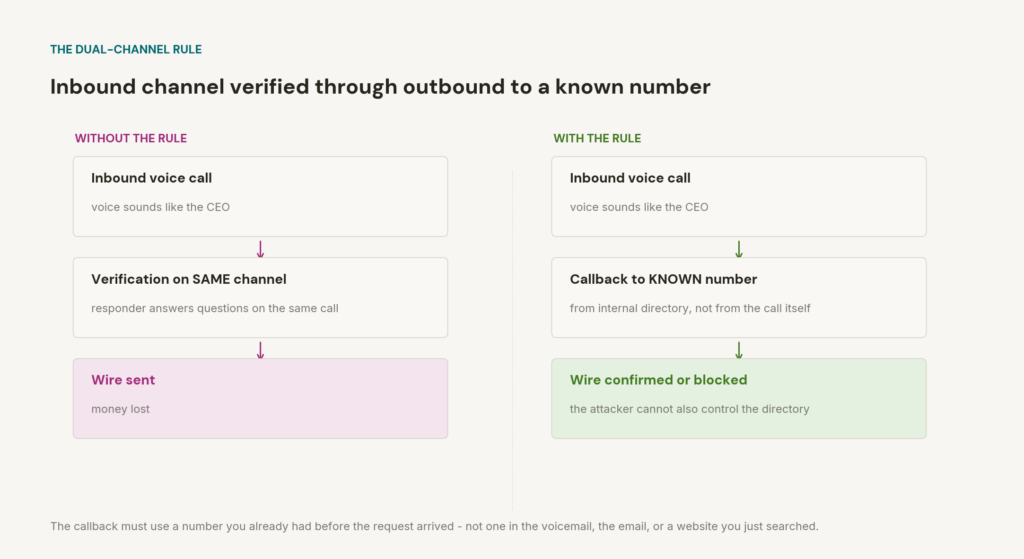
Any request to wire money, change vendor banking details, or release funds — received by phone, voicemail, or voice message — must be verified by calling the requester back at a known phone number stored in your contacts or HRIS, before the funds move. No exceptions. Not even from the CEO. Especially from the CEO.
Six controls every Hudson Valley and tristate SMB should have in place by July 1, 2026
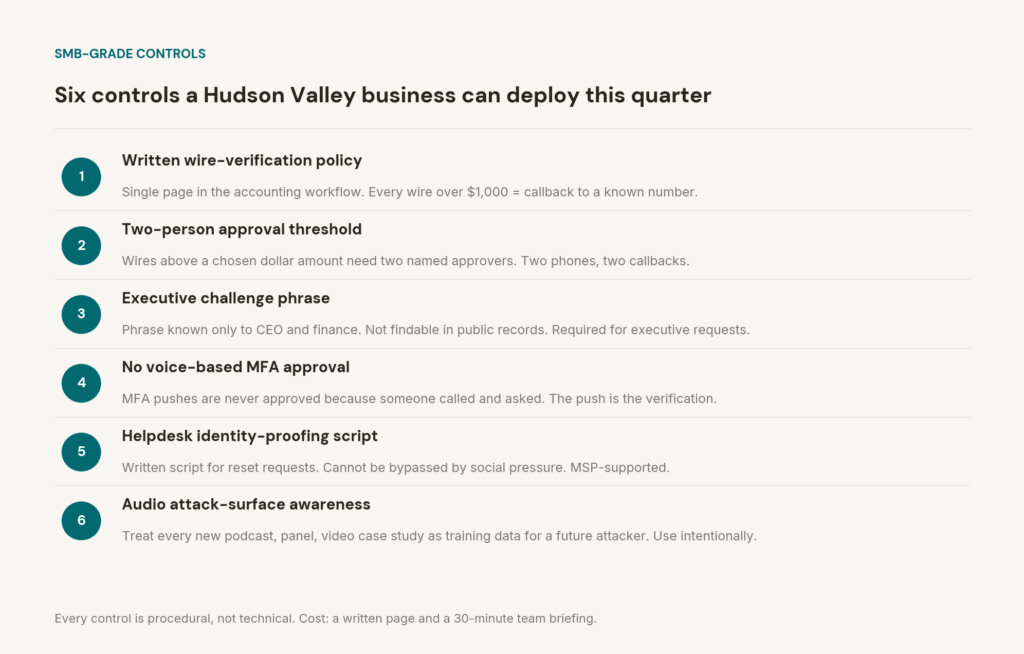
- Written wire-verification policy — signed by every finance staffer, posted at the AP workstation.
- Two-person approval threshold — any wire over $10,000 requires a second human approval through a different channel (Teams, email, in-person).
- Executive challenge phrase — a rotating word or phrase only the real executive knows. If the voice can’t produce it, the call ends.
- No voice-based MFA approval — never approve a Microsoft 365, Duo, or banking MFA push because someone called and asked you to.
- Helpdesk identity-proofing script — your IT provider should never reset an MFA token or password based on a voice call alone. This is where MSP partnership matters.)
- Audio attack-surface awareness — assume every LinkedIn video, podcast clip, and voicemail greeting is training data for an attacker.
Where AI defense fits into a modern Managed IT and cybersecurity stack
Voice cloning is just the first AI-enabled threat that crosses from research papers into your inbox. Deepfake video for board meetings, AI-generated phishing emails that mirror your CFO’s writing style, and AI-assisted reconnaissance against your VoIP system are already in active use against SMBs in the tristate area.
The defense isn’t more anti-virus. It is an AI-aware managed IT and cybersecurity stack that combines procedural controls (like the dual-channel rule above), AI-assisted threat detection on your endpoints, and an AI usage policy that defines what your team can and cannot do with ChatGPT, Copilot, and other generative tools.
For Hudson Valley and tristate businesses, this means three things working together:
- AI-assisted threat detection — endpoint and email security platforms that use machine learning to spot deepfake audio, AI-generated phishing, and behavioral anomalies traditional rules miss.
- An AI usage policy — a written document that tells your team which AI tools are approved, what data can be pasted into them, and how to handle AI-generated content received from outside the company.
- A managed service provider that understands AI — not just running ChatGPT for marketing, but architecting AI integration for your business in a way that adds productivity without opening new attack surfaces.
What to do if you think it just happened
- Do not hang up in panic — keep the caller talking and route a colleague to call the executive at a known number simultaneously.
- If a wire was already sent: call your bank’s fraud line within the hour — funds can sometimes be recalled if reported within 24 hours.
- File an IC3 report at ic3.gov — required for cyber-insurance claims.
- Notify your cyber insurance carrier within the policy’s reporting window (typically 24–72 hours).
- Preserve the call: phone-system logs, voicemail, caller-ID metadata. Forensics needs all of it.
The Fisch Solutions take
We’ve deployed dual-channel verification policies across every managed-services client in the Hudson Valley over the last 90 days. Zero successful voice-cloning fraud incidents on our books. The control is not technical — it is procedural. AI made the attack cheap; a 30-second callback makes the defense free.
Fisch Solutions is the Hudson Valley MSP that treats AI as both a productivity tool to deploy and a threat to defend against. We help businesses across Orange, Dutchess, Ulster, Putnam, Rockland, and the tristate area build out AI-integrated managed IT, AI-assisted cybersecurity, and the policies that keep both safe. CRN MSP 500 listed in 2025 and 2026.
If you want us to draft your wire-verification policy, train your finance team in 45 minutes, and audit your AI security posture in the same visit — contact our team.
Can AI voice cloning really fool my CFO?
Yes. Microsoft’s VALL-E and open-source models like XTTS-v2 produce around 85% voice accuracy from three seconds of audio. Trained ears cannot reliably distinguish them. Procedural controls — not human listening — are the defense.
What is the dual-channel verification rule?
Any request to move money, change vendor banking details, or release funds — received by phone or voicemail — must be verified by calling the requester back at a known phone number from your contacts or HRIS before the funds move. No exceptions.
Does Fisch Solutions help Hudson Valley businesses implement AI safely?
Yes. We provide AI integration consulting, AI usage policy drafting, AI-assisted cybersecurity, and managed IT services for businesses across Orange, Dutchess, Ulster, Putnam, Rockland Counties and the tristate area.
How much does it cost to implement these controls?
The procedural controls (dual-channel rule, written policy, executive challenge phrase) cost zero. The technical layer (AI-assisted email security, EDR with behavioral analysis, identity-proofing for helpdesk) is part of a standard managed cybersecurity stack starting around $75-$125 per user per month.
What should a Hudson Valley business do first?
Write and post the dual-channel verification policy this week. Then book a cybersecurity assessment with an MSP that understands AI threats. Fisch Solutions provides free assessments for Hudson Valley and tristate businesses — contact our team.
Federal Bureau of Investigation, Internet Crime Complaint Center — ic3.gov
Microsoft Research, VALL-E voice cloning project — microsoft.com/en-us/research/project/vall-e-x
Regula Forensics deepfake research — regulaforensics.com
Programs.com 2026 vishing statistics — programs.com/resources/voice-phishing-stats


